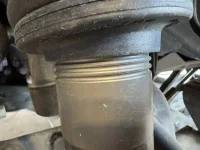
So, as promised, I did more road testing this cool am: I again drove down to the turn-around and back home with my OT in stock form. The ride was a bit bumpy just as I noticed in the first run a few days ago. I then pulled the 15A blue AVS-IGR fuse (located in the passenger-side FB) and went for another spin. The ride quality seemed to be significantly improved, maybe not on what I would expect from a Lexus, but quite a bit smoother and no error messages. I plan to leave the fuse out and get some more feedback from other trips. I am not sure how the now de-energized sensors are utilized in other ways - I see from the schematics that the wiring is used in the Stabilizer Control ECU and Skid Control ECUs. I would imagine that these ECU systems are affected if the original shocks are replaced during a lift kit install. Your thoughts?
Great info Garauld!
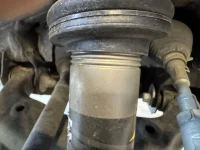
When I ran my OBD scanner after disabling and removing the AVS components, I didn’t see any other error or issue code, other than the one for each corner of the AVS being disconnected, not communicating, etc.
I’m completely unqualified to say for sure, but only can guess…
The Skid Control system obviously would use several other sensors, inputs. The AVS type OE Tokico shocks would be able to contribute somewhat to firming up nose dive, helping mitigate excess lean, etc..during emergency type situations, skid recovery, etc. However, I’m guessing that the VSC is not predominantly reliant on AVS. The ECU may in fact be looking at/for AVS input, and simply would direct other resources (maybe steering, ABS, EKDSS, etc) and sensors to make up any AVS shortfall. So since most lift kits supply a firmer spring and modern multi-valved shock…which handle sudden inputs extremely well.., the sensors being used by the VSC won’t be affected too much; you’ll still have the default mechanical resistance of a modern lift kit working in your favor. Instead of an ECU relying on firmware, software to adjust the shock.
The Stabilizer Control ECU (you’re referring to the EKDSS, I assume?) will use some of the same sensors (speed, turning rate, forces, normal driving mode input vs. the MTS or Crawl control, etc) to determine what to do.
That’s perhaps why now - with no AVS in the loop - at very low city speeds on pavement (I previously mentioned round-about, sharp 90 degree turns, transition from driveway or parking lots to the roadway, etc) I can notice a bit more lean and/or nose dive on my new suspension. However, as speeds increase that essentially goes away, the ride is much better, the very controlled ‘float’ and plushness are far nicer.
And at very high speeds when I've had to make quick adjustments to speed, steering input, flying up roads like Monarch pass, etc..the new suspension feels very robust, predictable, and confident.